
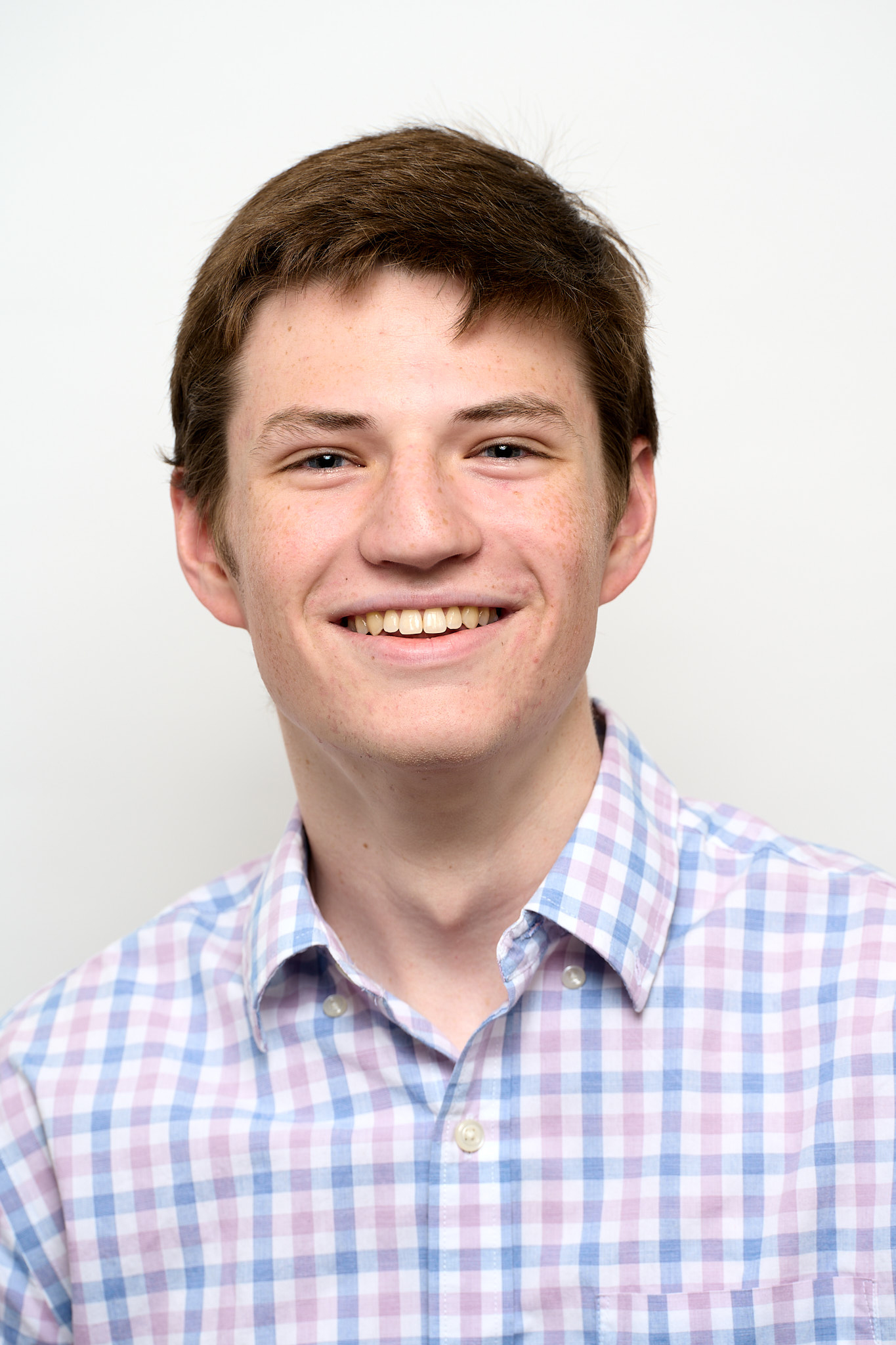
Andrew McAlinden
Stamps Forty Acres Scholarship, supported by Joanie & Doug Aron and Rebekah & Gary Reaves
Forty Acres Scholars Class of 2026
Hometown
Austin, Texas
High School
Vandergrift High School
Growing up in a small town in California, I coasted. School came easily, so I never pushed. I filled my time with TV and video games, not because they were deeply satisfying, but because they were effortless. I was concerned with doing what I had to, never what I could.
Then my family moved to Austin, and everything changed. The marching band had won a grand national championship. A kid in the grade below me won both the national spelling bee and the national geography bee. Athletes were being recruited to play at the highest level. For the first time, I saw what was possible when people refused to coast, and something in me shifted.
The transformation wasn't instant; change never is. But I began replacing idle hours with pursuits that actually engaged me, and I discovered something I hadn't expected: the hard thing was the enjoyable thing. A day spent struggling through a problem left me fulfilled. A day spent doing nothing left me hollow.
Computer science found me through pure luck. I planned to play tennis freshman year, but the week before tryouts, I broke my toe by stubbing it against a coffee table. The injury kept me off the team, and I was forced to find another class. I chose computer science without knowing what it was, and it turned out to be the purest form of something I had loved my entire life: puzzle solving. The same part of me that spent years figuring out how to solve Rubik's cubes from scratch and grinding through brainteaser apps on my phone had finally found a discipline and a future.
I took to coding quickly and began building things. I wrote a program that solves Rubik's cubes. I trained a neural network to help a robot autonomously collect tennis balls on a court. I competed in USACO, Google Kickstart, and UIL Computer Science. But the further I went, the more I found walls worth running into. I scored a 28 at my first UIL math competition while my friends cleared 100. I spent months debugging robot hardware on a Raspberry Pi with no documentation to guide me. Each failure sharpened something that early success never could have.
There is a counterintuitive truth at the center of all of this: struggle creates joy. The grind of failing, adjusting, and failing again until something finally clicks produces a fulfillment that nothing passive ever will. I know this because I spent years testing the alternative.
As I begin my next chapter at UT Austin, I carry this understanding with me. I intend to chase difficulty, through research, through competition, through community, and I look forward to finding, alongside my fellow Forty Acres Scholars, how much further we can push when we struggle together.
Major
Computer Science and Mathematics
Honors Program
Turing Scholars
Other Academic Interests
Finance
Extracurricular Activities:
Texas Undergraduate Investment Team (TUIT), UT Programming Contest (UTPC)
What drew you to the Forty Acres Scholars Program?
I have always performed my best when I am surrounded by people who are better than me at something. FASP offers exactly that: a small cohort of around 20 students who are all driven to do something meaningful with their lives. Being integrated into a community like that for four years, forming deep bonds with people who challenge and inspire me, is the kind of opportunity that can permanently change the trajectory of a person's life.
Beyond the community, the enrichment stipend would allow me to pursue research without financial compromise. The global experience would challenge the way I think in ways that staying in one place never could. And because FASP is the only program of its kind run by an alumni association, the connection to the Texas Exes network is not an afterthought: it is the foundation. I want to learn from those who have already walked the paths I am just starting on.
The more I learned about FASP at Finalist Weekend, the more it felt like exactly what I was looking for, and being here now has only proven that instinct correct.
Favorite FASP Memory:
Playing cards on our senior trip while enjoying the local refreshments of Belize!