
Forty Acres Scholars Share Life-Changing Experiences at Enrichment Symposium
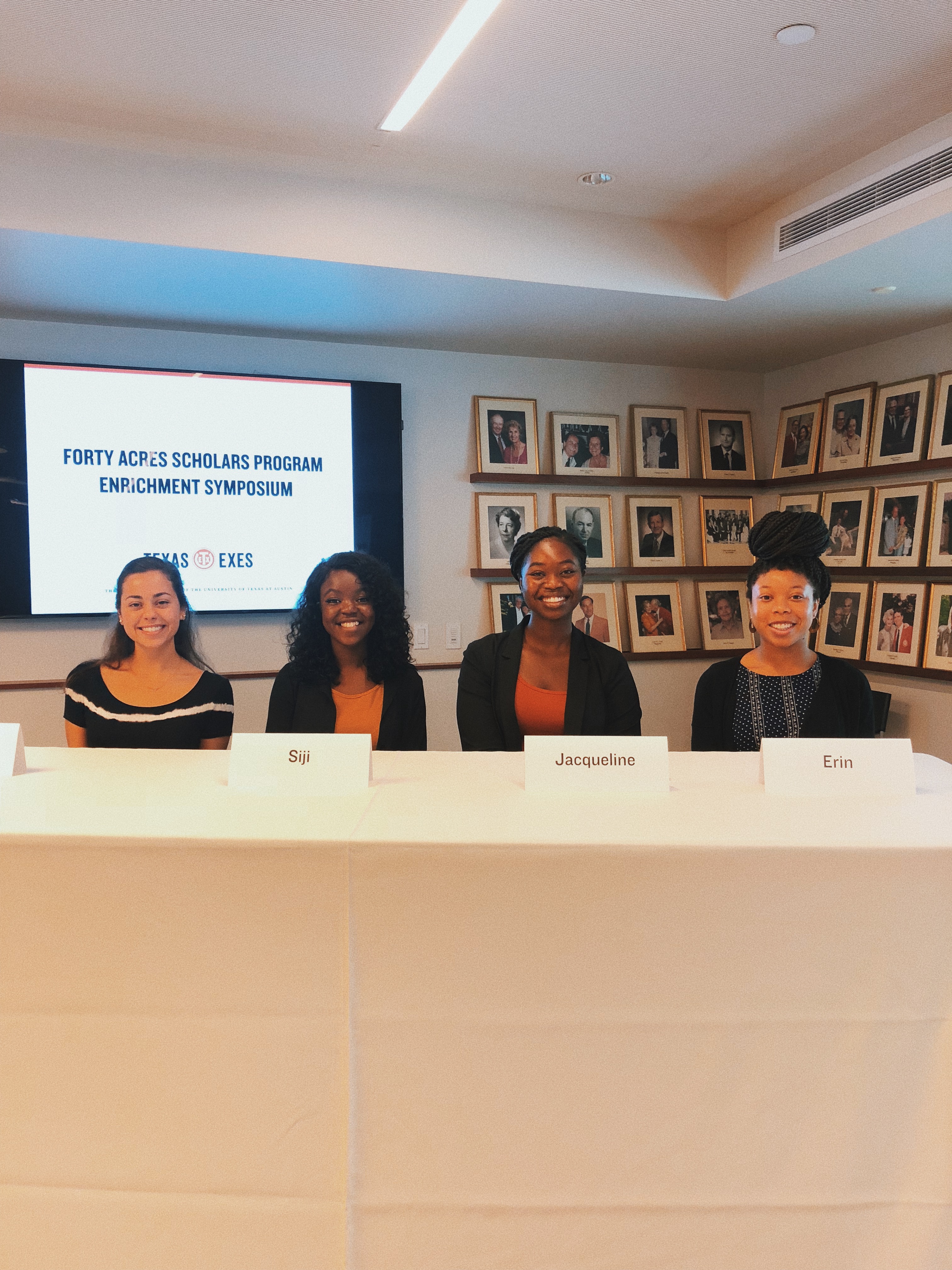
Learning from top professors across a wide array of fields while working toward a UT degree is an invaluable part life on the Forty Acres. But it’s the experiences that students have outside of the classroom that often prove to be more important. That was certainly the case for the 25 Forty Acres Scholars who shared their transformative adventures at the inaugural Forty Acres Scholars Program Enrichment Symposium on Friday, Sept. 21.
Alongside academic achievement, the Forty Acres Scholars Program focuses on personal development, relationship building, and gaining perspective. The goal of the $13,000 enrichment stipend available to each scholar is to allow Forty Acres Scholars to really make the most of their time at UT by helping them travel the world, volunteer for organizations they believe in, and work alongside professionals in their field.
The symposium allowed scholars who used funds from their enrichment stipend in the past year to share their stories across seven sessions, each featuring a panel of students grouped by study abroad, internships and research, service, and professional conferences. David Jones, BS ’68, MS ’70, Life Member, Texas Exes Board Member and chair of the Scholarship Advisory Committee, prompted the scholars with questions that helped them reflect on the impact of their enrichment experience.
Jacqueline Gibson, a senior Forty Acres Scholar studying computer science and African and African diaspora studies, shared her experience from a Maymester in Ghana that centered on community and social development. Gibson says the study abroad program helped open her eyes to different perspectives, cultures, and even her own identity and goals for the future.
“I realized that what I want to do to combat the digital divide doesn’t have to just be solely here, and I’m going to try to get involved with the 4Afrika initiative with Microsoft and try to bring the first technical center to Western Africa there,” Gibson says. “It was good for me to link what I experienced to what I was passionate about and kind of change my trajectory.”
These enrichment experiences also allowed the scholars to learn more about themselves. For Forty Acres Scholar Siji Deleawe, a Plan II and business honors junior, being in the lush environment of Costa Rica set a peaceful and introspective tone for her student leadership studies program.
“We were learning about leadership, but we were also learning about our personal emotional intelligence and our specific philosophy on leadership,” Deleawe says. “I learned that I really enjoy being pushed out of my comfort zone, and that my biggest strength is absorbing new information.”
The invaluable hands-on and real world ventures brought students to new places around the world to learn, including Forty Acres Scholar Sabrina Benitez, a pre-med biology honors sophomore who had never been abroad before. The enrichment stipend supported Benitez as a member of the Atlantis Fellowship Program, which placed her in Milan, Italy, to shadow doctors in different fields. She says seeing the life of a doctor firsthand was an enriching experience.
“Sometimes I’d been sitting with a doctor and they’d be doing paperwork, other times they’d be celebrating after a successful surgery, other times they’d have to deliver bad news to a patient,” Benitez says. I was able to see all the different aspects of being a doctor and this experience really reaffirmed my goals of getting a degree in medicine.”
We would like to extend our sincere thanks and gratitude to Jones and all of the Forty Acres Scholars who participated in this inaugural symposium. Below is a list of scholars who participated in the Enrichment Symposium.
Professional Conference
Cole Bennette: Texas Exes New York Chapter; NYC Seminar; New York City, New York
Jacqueline Gibson: National Center for Women & Information Technology Summit on Women and Computing; Grapevine, Texas
Study Abroad (Non-Europe Countries)
Erin Backus: Maymester: Community and Social Development; Ghana, Africa
Siji Deleawe: Socially Responsible and Ethical Student Leadership; San Joaquin de Flores, Costa Rica
Jacqueline Gibson: Maymester: Community and Social Development; Ghana, Africa
Sophia Guirola: Climate Change, Ecosystems, and Human Dynamics; Ghanzi, Botswana
Service
Janelle Chavez: Global Medical Training; Santo Domingo, Domincan Republic
Mandy Jústiz: Global Medical Training; Peru
Study Abroad (Business Programs)
Ricky Cooks: BHP International Management; Buenos Aires, Argentina
Carlyn Crow: BHP International Management; Buenos Aires, Argentina
Emily Gex: Finance Program in London; London, England
Scott Kennedy: Finance Program in London; London, England
Internship & Research
Manjula Andukuri: International Leadership Foundation Civic Fellowship; Washington, D.C.
Sabrina Benitez: Atlantis Fellowship Program; Milan, Italy
Ale Flores: EY Launch; San Jose, California
Shilpa Rajagopal: Cancer Prevention & Research Institute of Texas (CPRIT)-CURE Summer Undergraduate Research Program; Houston, Texas
Omar Mata: Summer International Internship Program; Shenzen, China
Study Abroad (Semester Away)
Ale Flores: Chinese University of Hong Kong; Hong Kong, China
Chandler Groves: City University London; London, England
Alex Rabinovich: Hong Kong University of Science and Technology; Hong Kong, China
Audrey Urbis: University of Edinburgh; Edinburgh, Scotland
Study Abroad (Europe Countries)
Olivia Cardenas: Pope Francis’ Catholic Church: The Making of the Modern Papacy; Rome, Italy
Ashley Deutser: Pope Francis’ Catholic Church: The Making of the Modern Papacy; Rome Italy
Skyler Frost: The International Summer School: University of Oslo; Oslo, Norway
Chessie Reece: Maymester: The U.S., U.K., and World Order; London, England
Lauren Smith: Maymester: Documentary Photography Storytelling; Prague, Czech Republic
Feature
Box List 1 - Featured - Default Paragraph Style
Box List 1 - Teaser - Default Paragraph Style
Lede Image
Search Result - Default Paragraph Style
View List - Default Paragraph Style
Box List 1 - Featured
Forty Acres Scholars Share Life-Changing Experiences at Enrichment Symposium
Learning from top professors across a wide array of fields while working toward a UT degree is an invaluable part life on the Forty Acres. But it’s the experiences that students have outside of the classroom that often prove to be more important. That was certainly the case for the 25 Forty Acres Scholars who shared their transformative adventures at the inaugural Forty Acres Scholars Program Enrichment Symposium on Friday, Sept. 21. Alongside academic achievement, the Forty Acres Scholars Program focuses on personal development, relationship building, and gaining perspective. The goal of the $13,000 enrichment stipend available to each scholar is to allow Forty Acres Scholars to really make the most of their time at UT by helping them travel the world, volunteer for organizations they believe in, and work alongside professionals in their field. The symposium allowed scholars who used funds from their enrichment stipend in the past year to share their stories across seven sessions, each featuring a panel of students grouped by study abroad, internships and research, service, and professional conferences. David Jones, BS ’68, MS ’70, Life Member, Texas Exes Board Member and chair of the Scholarship Advisory Committee, prompted the scholars with questions that helped them reflect on the impact of their enrichment experience. Jacqueline Gibson, a senior Forty Acres Scholar studying computer science and African and African diaspora studies, shared her experience from a Maymester in Ghana that centered on community and social development. Gibson says the study abroad program helped open her eyes to different perspectives, cultures, and even her own identity and goals for the future. “I realized that what I want to do to combat the digital divide doesn’t have to just be solely here, and I’m going to try to get involved with the 4Afrika initiative with Microsoft and try to bring the first technical center to Western Africa there,” Gibson says. “It was good for me to link what I experienced to what I was passionate about and kind of change my trajectory.” These enrichment experiences also allowed the scholars to learn more about themselves. For Forty Acres Scholar Siji Deleawe, a Plan II and business honors junior, being in the lush environment of Costa Rica set a peaceful and introspective tone for her student leadership studies program. “We were learning about leadership, but we were also learning about our personal emotional intelligence and our specific philosophy on leadership,” Deleawe says. “I learned that I really enjoy being pushed out of my comfort zone, and that my biggest strength is absorbing new information.” The invaluable hands-on and real world ventures brought students to new places around the world to learn, including Forty Acres Scholar Sabrina Benitez, a pre-med biology honors sophomore who had never been abroad before. The enrichment stipend supported Benitez as a member of the Atlantis Fellowship Program, which placed her in Milan, Italy, to shadow doctors in different fields. She says seeing the life of a doctor firsthand was an enriching experience. “Sometimes I’d been sitting with a doctor and they’d be doing paperwork, other times they’d be celebrating after a successful surgery, other times they’d have to deliver bad news to a patient,” Benitez says. I was able to see all the different aspects of being a doctor and this experience really reaffirmed my goals of getting a degree in medicine.” We would like to extend our sincere thanks and gratitude to Jones and all of the Forty Acres Scholars who participated in this inaugural symposium. Below is a list of scholars who participated in the Enrichment Symposium. Professional Conference Cole Bennette: Texas Exes New York Chapter; NYC Seminar; New York City, New York Jacqueline Gibson: National Center for Women & Information Technology Summit on Women and Computing; Grapevine, Texas Study Abroad (Non-Europe Countries) Erin Backus: Maymester: Community and Social Development; Ghana, Africa Siji Deleawe: Socially Responsible and Ethical Student Leadership; San Joaquin de Flores, Costa Rica Jacqueline Gibson: Maymester: Community and Social Development; Ghana, Africa Sophia Guirola: Climate Change, Ecosystems, and Human Dynamics; Ghanzi, Botswana Service Janelle Chavez: Global Medical Training; Santo Domingo, Domincan Republic Mandy Jústiz: Global Medical Training; Peru Study Abroad (Business Programs) Ricky Cooks: BHP International Management; Buenos Aires, Argentina Carlyn Crow: BHP International Management; Buenos Aires, Argentina Emily Gex: Finance Program in London; London, England Scott Kennedy: Finance Program in London; London, England Internship & Research Manjula Andukuri: International Leadership Foundation Civic Fellowship; Washington, D.C. Sabrina Benitez: Atlantis Fellowship Program; Milan, Italy Ale Flores: EY Launch; San Jose, California Shilpa Rajagopal: Cancer Prevention & Research Institute of Texas (CPRIT)-CURE Summer Undergraduate Research Program; Houston, Texas Omar Mata: Summer International Internship Program; Shenzen, China Study Abroad (Semester Away) Ale Flores: Chinese University of Hong Kong; Hong Kong, China Chandler Groves: City University London; London, England Alex Rabinovich: Hong Kong University of Science and Technology; Hong Kong, China Audrey Urbis: University of Edinburgh; Edinburgh, Scotland Study Abroad (Europe Countries) Olivia Cardenas: Pope Francis’ Catholic Church: The Making of the Modern Papacy; Rome, Italy Ashley Deutser: Pope Francis’ Catholic Church: The Making of the Modern Papacy; Rome Italy Skyler Frost: The International Summer School: University of Oslo; Oslo, Norway Chessie Reece: Maymester: The U.S., U.K., and World Order; London, England Lauren Smith: Maymester: Documentary Photography Storytelling; Prague, Czech Republic
Box List 1 - Teaser
Forty Acres Scholars Share Life-Changing Experiences at Enrichment Symposium
Learning from top professors across a wide array of fields while working toward a UT degree is an invaluable part life on the Forty Acres. But it’s the experiences that students have outside of the classroom that often prove to be more important. That was certainly the case for the 25 Forty Acres Scholars who shared their transformative adventures at the inaugural Forty Acres Scholars Program Enrichment Symposium on Friday, Sept. 21. Alongside academic achievement, the Forty Acres Scholars Program focuses on personal development, relationship building, and gaining perspective. The goal of the $13,000 enrichment stipend available to each scholar is to allow Forty Acres Scholars to really make the most of their time at UT by helping them travel the world, volunteer for organizations they believe in, and work alongside professionals in their field. The symposium allowed scholars who used funds from their enrichment stipend in the past year to share their stories across seven sessions, each featuring a panel of students grouped by study abroad, internships and research, service, and professional conferences. David Jones, BS ’68, MS ’70, Life Member, Texas Exes Board Member and chair of the Scholarship Advisory Committee, prompted the scholars with questions that helped them reflect on the impact of their enrichment experience. Jacqueline Gibson, a senior Forty Acres Scholar studying computer science and African and African diaspora studies, shared her experience from a Maymester in Ghana that centered on community and social development. Gibson says the study abroad program helped open her eyes to different perspectives, cultures, and even her own identity and goals for the future. “I realized that what I want to do to combat the digital divide doesn’t have to just be solely here, and I’m going to try to get involved with the 4Afrika initiative with Microsoft and try to bring the first technical center to Western Africa there,” Gibson says. “It was good for me to link what I experienced to what I was passionate about and kind of change my trajectory.” These enrichment experiences also allowed the scholars to learn more about themselves. For Forty Acres Scholar Siji Deleawe, a Plan II and business honors junior, being in the lush environment of Costa Rica set a peaceful and introspective tone for her student leadership studies program. “We were learning about leadership, but we were also learning about our personal emotional intelligence and our specific philosophy on leadership,” Deleawe says. “I learned that I really enjoy being pushed out of my comfort zone, and that my biggest strength is absorbing new information.” The invaluable hands-on and real world ventures brought students to new places around the world to learn, including Forty Acres Scholar Sabrina Benitez, a pre-med biology honors sophomore who had never been abroad before. The enrichment stipend supported Benitez as a member of the Atlantis Fellowship Program, which placed her in Milan, Italy, to shadow doctors in different fields. She says seeing the life of a doctor firsthand was an enriching experience. “Sometimes I’d been sitting with a doctor and they’d be doing paperwork, other times they’d be celebrating after a successful surgery, other times they’d have to deliver bad news to a patient,” Benitez says. I was able to see all the different aspects of being a doctor and this experience really reaffirmed my goals of getting a degree in medicine.” We would like to extend our sincere thanks and gratitude to Jones and all of the Forty Acres Scholars who participated in this inaugural symposium. Below is a list of scholars who participated in the Enrichment Symposium. Professional Conference Cole Bennette: Texas Exes New York Chapter; NYC Seminar; New York City, New York Jacqueline Gibson: National Center for Women & Information Technology Summit on Women and Computing; Grapevine, Texas Study Abroad (Non-Europe Countries) Erin Backus: Maymester: Community and Social Development; Ghana, Africa Siji Deleawe: Socially Responsible and Ethical Student Leadership; San Joaquin de Flores, Costa Rica Jacqueline Gibson: Maymester: Community and Social Development; Ghana, Africa Sophia Guirola: Climate Change, Ecosystems, and Human Dynamics; Ghanzi, Botswana Service Janelle Chavez: Global Medical Training; Santo Domingo, Domincan Republic Mandy Jústiz: Global Medical Training; Peru Study Abroad (Business Programs) Ricky Cooks: BHP International Management; Buenos Aires, Argentina Carlyn Crow: BHP International Management; Buenos Aires, Argentina Emily Gex: Finance Program in London; London, England Scott Kennedy: Finance Program in London; London, England Internship & Research Manjula Andukuri: International Leadership Foundation Civic Fellowship; Washington, D.C. Sabrina Benitez: Atlantis Fellowship Program; Milan, Italy Ale Flores: EY Launch; San Jose, California Shilpa Rajagopal: Cancer Prevention & Research Institute of Texas (CPRIT)-CURE Summer Undergraduate Research Program; Houston, Texas Omar Mata: Summer International Internship Program; Shenzen, China Study Abroad (Semester Away) Ale Flores: Chinese University of Hong Kong; Hong Kong, China Chandler Groves: City University London; London, England Alex Rabinovich: Hong Kong University of Science and Technology; Hong Kong, China Audrey Urbis: University of Edinburgh; Edinburgh, Scotland Study Abroad (Europe Countries) Olivia Cardenas: Pope Francis’ Catholic Church: The Making of the Modern Papacy; Rome, Italy Ashley Deutser: Pope Francis’ Catholic Church: The Making of the Modern Papacy; Rome Italy Skyler Frost: The International Summer School: University of Oslo; Oslo, Norway Chessie Reece: Maymester: The U.S., U.K., and World Order; London, England Lauren Smith: Maymester: Documentary Photography Storytelling; Prague, Czech Republic
Search Result
Forty Acres Scholars Share Life-Changing Experiences at Enrichment Symposium
Learning from top professors across a wide array of fields while working toward a UT degree is an invaluable part life on the Forty Acres. But it’s the experiences that students have outside of the classroom that often prove to be more important. That was certainly the case for the 25 Forty Acres Scholars who shared their transformative adventures at the inaugural Forty Acres Scholars Program Enrichment Symposium on Friday, Sept. 21. Alongside academic achievement, the Forty Acres Scholars Program focuses on personal development, relationship building, and gaining perspective. The goal of the $13,000 enrichment stipend available to each scholar is to allow Forty Acres Scholars to really make the most of their time at UT by helping them travel the world, volunteer for organizations they believe in, and work alongside professionals in their field. The symposium allowed scholars who used funds from their enrichment stipend in the past year to share their stories across seven sessions, each featuring a panel of students grouped by study abroad, internships and research, service, and professional conferences. David Jones, BS ’68, MS ’70, Life Member, Texas Exes Board Member and chair of the Scholarship Advisory Committee, prompted the scholars with questions that helped them reflect on the impact of their enrichment experience. Jacqueline Gibson, a senior Forty Acres Scholar studying computer science and African and African diaspora studies, shared her experience from a Maymester in Ghana that centered on community and social development. Gibson says the study abroad program helped open her eyes to different perspectives, cultures, and even her own identity and goals for the future. “I realized that what I want to do to combat the digital divide doesn’t have to just be solely here, and I’m going to try to get involved with the 4Afrika initiative with Microsoft and try to bring the first technical center to Western Africa there,” Gibson says. “It was good for me to link what I experienced to what I was passionate about and kind of change my trajectory.” These enrichment experiences also allowed the scholars to learn more about themselves. For Forty Acres Scholar Siji Deleawe, a Plan II and business honors junior, being in the lush environment of Costa Rica set a peaceful and introspective tone for her student leadership studies program. “We were learning about leadership, but we were also learning about our personal emotional intelligence and our specific philosophy on leadership,” Deleawe says. “I learned that I really enjoy being pushed out of my comfort zone, and that my biggest strength is absorbing new information.” The invaluable hands-on and real world ventures brought students to new places around the world to learn, including Forty Acres Scholar Sabrina Benitez, a pre-med biology honors sophomore who had never been abroad before. The enrichment stipend supported Benitez as a member of the Atlantis Fellowship Program, which placed her in Milan, Italy, to shadow doctors in different fields. She says seeing the life of a doctor firsthand was an enriching experience. “Sometimes I’d been sitting with a doctor and they’d be doing paperwork, other times they’d be celebrating after a successful surgery, other times they’d have to deliver bad news to a patient,” Benitez says. I was able to see all the different aspects of being a doctor and this experience really reaffirmed my goals of getting a degree in medicine.” We would like to extend our sincere thanks and gratitude to Jones and all of the Forty Acres Scholars who participated in this inaugural symposium. Below is a list of scholars who participated in the Enrichment Symposium. Professional Conference Cole Bennette: Texas Exes New York Chapter; NYC Seminar; New York City, New York Jacqueline Gibson: National Center for Women & Information Technology Summit on Women and Computing; Grapevine, Texas Study Abroad (Non-Europe Countries) Erin Backus: Maymester: Community and Social Development; Ghana, Africa Siji Deleawe: Socially Responsible and Ethical Student Leadership; San Joaquin de Flores, Costa Rica Jacqueline Gibson: Maymester: Community and Social Development; Ghana, Africa Sophia Guirola: Climate Change, Ecosystems, and Human Dynamics; Ghanzi, Botswana Service Janelle Chavez: Global Medical Training; Santo Domingo, Domincan Republic Mandy Jústiz: Global Medical Training; Peru Study Abroad (Business Programs) Ricky Cooks: BHP International Management; Buenos Aires, Argentina Carlyn Crow: BHP International Management; Buenos Aires, Argentina Emily Gex: Finance Program in London; London, England Scott Kennedy: Finance Program in London; London, England Internship & Research Manjula Andukuri: International Leadership Foundation Civic Fellowship; Washington, D.C. Sabrina Benitez: Atlantis Fellowship Program; Milan, Italy Ale Flores: EY Launch; San Jose, California Shilpa Rajagopal: Cancer Prevention & Research Institute of Texas (CPRIT)-CURE Summer Undergraduate Research Program; Houston, Texas Omar Mata: Summer International Internship Program; Shenzen, China Study Abroad (Semester Away) Ale Flores: Chinese University of Hong Kong; Hong Kong, China Chandler Groves: City University London; London, England Alex Rabinovich: Hong Kong University of Science and Technology; Hong Kong, China Audrey Urbis: University of Edinburgh; Edinburgh, Scotland Study Abroad (Europe Countries) Olivia Cardenas: Pope Francis’ Catholic Church: The Making of the Modern Papacy; Rome, Italy Ashley Deutser: Pope Francis’ Catholic Church: The Making of the Modern Papacy; Rome Italy Skyler Frost: The International Summer School: University of Oslo; Oslo, Norway Chessie Reece: Maymester: The U.S., U.K., and World Order; London, England Lauren Smith: Maymester: Documentary Photography Storytelling; Prague, Czech Republic
View List
Forty Acres Scholars Share Life-Changing Experiences at Enrichment Symposium
Learning from top professors across a wide array of fields while working toward a UT degree is an invaluable part life on the Forty Acres. But it’s the experiences that students have outside of the classroom that often prove to be more important. That was certainly the case for the 25 Forty Acres Scholars who shared their transformative adventures at the inaugural Forty Acres Scholars Program Enrichment Symposium on Friday, Sept. 21. Alongside academic achievement, the Forty Acres Scholars Program focuses on personal development, relationship building, and gaining perspective. The goal of the $13,000 enrichment stipend available to each scholar is to allow Forty Acres Scholars to really make the most of their time at UT by helping them travel the world, volunteer for organizations they believe in, and work alongside professionals in their field. The symposium allowed scholars who used funds from their enrichment stipend in the past year to share their stories across seven sessions, each featuring a panel of students grouped by study abroad, internships and research, service, and professional conferences. David Jones, BS ’68, MS ’70, Life Member, Texas Exes Board Member and chair of the Scholarship Advisory Committee, prompted the scholars with questions that helped them reflect on the impact of their enrichment experience. Jacqueline Gibson, a senior Forty Acres Scholar studying computer science and African and African diaspora studies, shared her experience from a Maymester in Ghana that centered on community and social development. Gibson says the study abroad program helped open her eyes to different perspectives, cultures, and even her own identity and goals for the future. “I realized that what I want to do to combat the digital divide doesn’t have to just be solely here, and I’m going to try to get involved with the 4Afrika initiative with Microsoft and try to bring the first technical center to Western Africa there,” Gibson says. “It was good for me to link what I experienced to what I was passionate about and kind of change my trajectory.” These enrichment experiences also allowed the scholars to learn more about themselves. For Forty Acres Scholar Siji Deleawe, a Plan II and business honors junior, being in the lush environment of Costa Rica set a peaceful and introspective tone for her student leadership studies program. “We were learning about leadership, but we were also learning about our personal emotional intelligence and our specific philosophy on leadership,” Deleawe says. “I learned that I really enjoy being pushed out of my comfort zone, and that my biggest strength is absorbing new information.” The invaluable hands-on and real world ventures brought students to new places around the world to learn, including Forty Acres Scholar Sabrina Benitez, a pre-med biology honors sophomore who had never been abroad before. The enrichment stipend supported Benitez as a member of the Atlantis Fellowship Program, which placed her in Milan, Italy, to shadow doctors in different fields. She says seeing the life of a doctor firsthand was an enriching experience. “Sometimes I’d been sitting with a doctor and they’d be doing paperwork, other times they’d be celebrating after a successful surgery, other times they’d have to deliver bad news to a patient,” Benitez says. I was able to see all the different aspects of being a doctor and this experience really reaffirmed my goals of getting a degree in medicine.” We would like to extend our sincere thanks and gratitude to Jones and all of the Forty Acres Scholars who participated in this inaugural symposium. Below is a list of scholars who participated in the Enrichment Symposium. Professional Conference Cole Bennette: Texas Exes New York Chapter; NYC Seminar; New York City, New York Jacqueline Gibson: National Center for Women & Information Technology Summit on Women and Computing; Grapevine, Texas Study Abroad (Non-Europe Countries) Erin Backus: Maymester: Community and Social Development; Ghana, Africa Siji Deleawe: Socially Responsible and Ethical Student Leadership; San Joaquin de Flores, Costa Rica Jacqueline Gibson: Maymester: Community and Social Development; Ghana, Africa Sophia Guirola: Climate Change, Ecosystems, and Human Dynamics; Ghanzi, Botswana Service Janelle Chavez: Global Medical Training; Santo Domingo, Domincan Republic Mandy Jústiz: Global Medical Training; Peru Study Abroad (Business Programs) Ricky Cooks: BHP International Management; Buenos Aires, Argentina Carlyn Crow: BHP International Management; Buenos Aires, Argentina Emily Gex: Finance Program in London; London, England Scott Kennedy: Finance Program in London; London, England Internship & Research Manjula Andukuri: International Leadership Foundation Civic Fellowship; Washington, D.C. Sabrina Benitez: Atlantis Fellowship Program; Milan, Italy Ale Flores: EY Launch; San Jose, California Shilpa Rajagopal: Cancer Prevention & Research Institute of Texas (CPRIT)-CURE Summer Undergraduate Research Program; Houston, Texas Omar Mata: Summer International Internship Program; Shenzen, China Study Abroad (Semester Away) Ale Flores: Chinese University of Hong Kong; Hong Kong, China Chandler Groves: City University London; London, England Alex Rabinovich: Hong Kong University of Science and Technology; Hong Kong, China Audrey Urbis: University of Edinburgh; Edinburgh, Scotland Study Abroad (Europe Countries) Olivia Cardenas: Pope Francis’ Catholic Church: The Making of the Modern Papacy; Rome, Italy Ashley Deutser: Pope Francis’ Catholic Church: The Making of the Modern Papacy; Rome Italy Skyler Frost: The International Summer School: University of Oslo; Oslo, Norway Chessie Reece: Maymester: The U.S., U.K., and World Order; London, England Lauren Smith: Maymester: Documentary Photography Storytelling; Prague, Czech Republic